How to Protect Your Profit Margins When Facing Price Wars from Similar Tobacco Science Accounts


In mid-March 2024, I was in my Hangzhou Binjiang studio monitoring the backend. For two consecutive days, private messages kept asking the same question: "Why is your course nearly twice as expensive as Account X's?" The screenshot was clear: a similar account with a comparable follower count had listed their "Smoking Cessation Science Starter Pack" at 29.9 yuan, plus a free 7-day check-in group. Our standard price at the time was 59 yuan, with more comprehensive content duration and materials.


That week, we tentatively followed the price cut, temporarily dropping the starter pack to 39 yuan. The result was predictable: daily sales jumped from 11 orders to 26 over 7 days, but gross profit was nearly wiped out—outsourced layout, customer service, and volunteer subsidies for group management brought the per-order gross profit from about 28 yuan down to 9 yuan. Worse, inquiries for our flagship "21-Day Structured Follow-up Consultation" (then 398 yuan) dropped by about 40%. Some people directly said, "If the entry-level is this cheap, the consultation must be overpriced too."


My judgment at the time was firm: in a price war, what you lose most easily isn't traffic—it's that you personally train your users to "only recognize low prices." Since then, we've never pitted our core profit layer against others' price cuts. Instead, we moved the battlefield to differentiated offerings and high-value service lock-in. Here's how this approach is implemented and which pitfalls I've personally stepped into.


1. Why Following Price Cuts Almost Always Fails: Your Cost Structure Is Different
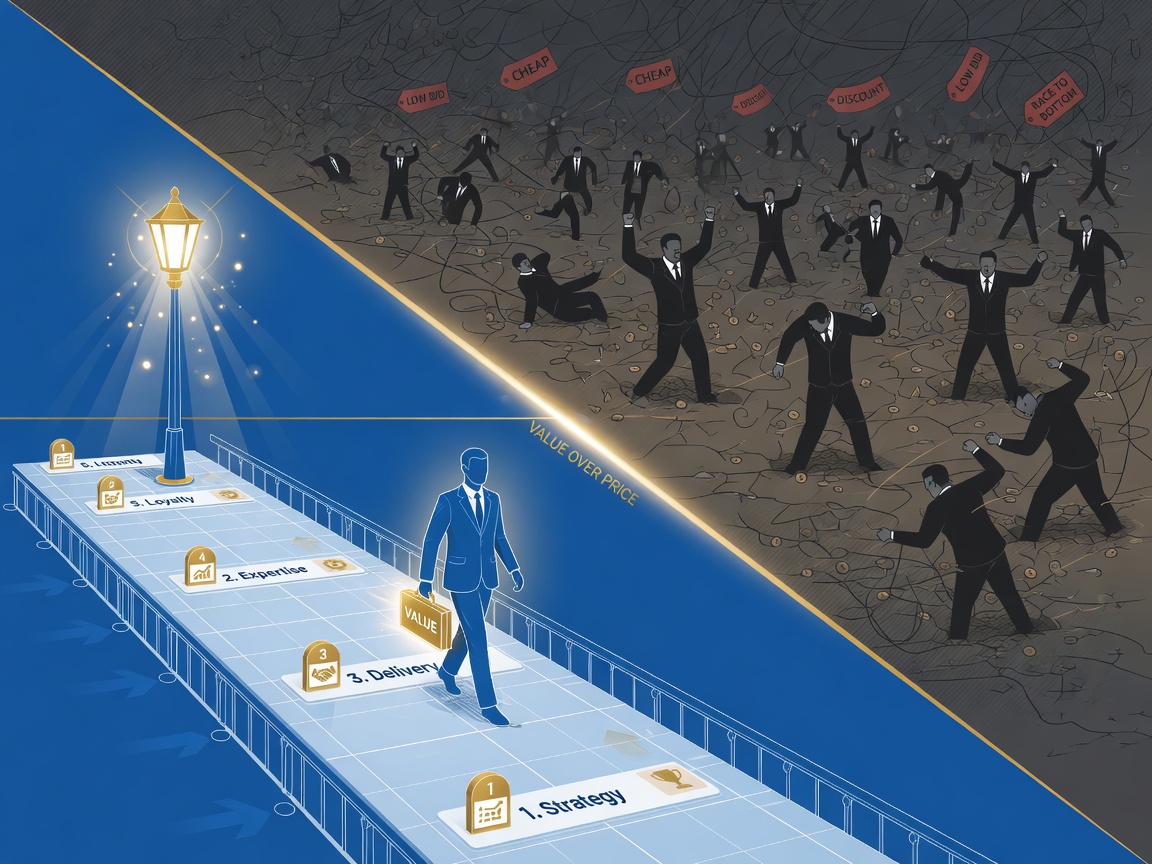
The essence of a price war is not a numbers game, but a battle for users' pricing mindset

Many people think a price war is about "who dares to cut more," but it's really about "whose fixed costs can be more easily ignored."


The delivery costs for tobacco/smoking cessation science accounts are substantial: verifying literature and guidelines, formatting charts, handling sensitive comments, ensuring compliance phrasing, and managing user emotions. In the second half of 2023, we conducted an internal cost analysis (roughly based on Hangzhou outsourcing market rates): one in-depth article of 2,500 characters with 3–5 self-made infographics cost about 180–260 yuan in total labor from topic selection to second proofreading. A single 40-minute voice consultation, including the host's time plus documentation, was hard to compress below 80 yuan in real cost. Selling your course for 29.9 yuan means you're also undervaluing the consultation and trust that follow.


The knowledge payment sector has a classic problem called the "lemon market": prices are public, but quality is hidden. Users can only rely on previews and low prices to trial products, causing high-quality offerings to be squeezed out of initial price comparisons. Since around 2016, the industry's shift from low-price customer acquisition to subsequent UGC sales expansion has repeatedly validated this—packaging and promotions once seemed more competitive than content itself. Public discussions also frequently remind us that relying solely on discounts rather than demonstrating unique value distorts success metrics into "who's cheaper," ruining both profit margins and brand positioning.


My personal view is clear: **entry-level products can be price-sensitive, but the profit layer must never follow price cuts.** Penetration pricing is suitable for grabbing market share; value pricing is what protects profits. As the market matures, blindly following competitive pricing ultimately leads to mutually destructive undercutting.


2. Differentiated Positioning: Stop Defining Yourself as "Another Tobacco Knowledge Account"


In April 2024, we conducted half a month of user interviews with 27 people, mostly recruited through private-domain questionnaires, each receiving a 20-yuan material voucher. The location wasn't important, but the recurring verbatim responses were:


  • "I don't need to know that smoking is harmful. I need to know how to get through next week's dinner party."
  • "Stop giving me a pile of mechanism diagrams. Tell me what happens on Day 3, Day 7, and what I should do."
  • "I want someone who can track my check-ins and call me out when I lie."

  • So we reframed our positioning from "Tobacco Harm Science" to one sentence:


    **"For those who have decided to reduce/quit smoking: a executable 21-day behavior plan + accountable follow-up."**


    By narrowing the focus, our content no longer collided with "daily trivia accounts." Competitors can explain nicotine half-lives cheaper than we can, but it's much harder for them to deliver "19:30 voice Q&A tonight + trigger journal template + relapse return visit" at a lower price. Differentiation isn't about changing your copy; it's about changing the ruler users use to compare you.


    Our actionable positioning test (still used internally):


    1. **Results are describable**: Users can articulate what behaviors they've reduced and what alternative actions they've added after 21 days.

    2. **Process is deliverable**: There must be forms, check-in milestones, and Q&A sessions—not just "reading more articles will fix it."

    3. **Hard for competitors to replicate**: It relies on your follow-up rhythm, case library, and the host's judgment, not just rehashing public literature.

    4. **Premium is explainable**: The value is in "someone managing results," not in "more PDF pages."


    If two of these four points are unclear, your so-called differentiation is just a slogan.


    3. Product Layering: Let Price Wars Happen at the Layer That Doesn't Hurt


    In May 2024, we restructured our product matrix. The approach was simple but effective: low price handles trust and screening, mid-price handles cash flow, and high price handles profit and lock-in.


    Only one key discipline: **L1 can bleed, but L2/L3 posted prices remain stable.**

    In June 2024, when a competitor copied our L1 and sold it for 9.9, we didn't keep undercutting. We just removed "one free 15-minute voice session" from L1 and replaced it with "a written trigger checklist." Sales dropped about 20%, but the L1→L2 upgrade rate rose from 8% to 14%—because those who came in understood: if you want to talk to someone, you need L2.


    A common principle in e-commerce and management practice is that "differentiation investment must be covered by premium pricing and repeat purchases," which holds true for content accounts. I use a rough budgetary constraint:


    **Differentiation improvement budget ≤ target customer annual contribution gross profit × expected repeat purchase increase × about 3 years.**


    Any "premium feel" investment that doesn't pass this test (e.g., spending heavily on useless animations) gets cut.


    4. High-Value Service Lock-in: Make the Cost of Leaving Higher Than Renewal


    Price wars compete for the "first transaction"; what you need to defend is "they come back to you a second time." Lock-in isn't hostage-taking—it's deepening outcome dependency.


    From July to September 2024, we tested four lock-in mechanisms in our private domain (enterprise WeChat, peak of about 1,860 effective contacts):


    **1. Progress Asset Lock**

    Users' trigger journals, withdrawal symptom records, and failure reviews filled during the 21 days are all stored in their personal document. If they leave midway, data can be exported, but they lose "continuous advice on how to adjust next." Most renewing members are motivated by "I don't want to explain my situation from scratch again."


    **2. Node Follow-up Lock**

    Structured return visits (not casual chat) are sent on fixed days 3, 7, 14, and 21. A complete follow-up package includes 2 voice sessions of 20–30 minutes plus a written summary. August 2024 statistics: users who completed all nodes had a 90-day renewal/repurchase rate of about 31%; those who lost contact for over 7 days dropped to around 6%. Service density itself is a barrier.


    **3. Community Rules Lock**

    Experience groups are kept for only 7 days, with advertisements and negative price comparisons prohibited. When someone posted a cut-price link in our group, we removed 11 people in May 2024. In the short term, it looked like "less activity," but long-term noise dropped, and serious executors were willing to pay for L2. High-value clients aren't afraid of high prices; they're afraid of a dirty environment.


    **4. Benefit Ladder Lock**

    L3 membership doesn't offer "ten more e-books." Instead, it provides: **priority Q&A queue (within 48 hours) + quarterly plan adjustment + relapse emergency script library updates.**

    In October 2024, we tried a "direct 100 yuan discount" renewal campaign. Renewal rates looked good short-term, but the next quarter everyone started waiting for discounts. In November, we switched to "renewal includes a family communication rehearsal (20-min voice)", kept the listed price unchanged, and maintained renewal rates at 24%–28%, with cleaner profits.


    Marketing often talks about shifting from "transaction metrics" to "relationships and lifetime value." For smaller accounts, this means: better to skip 10 one-time 29.9 sales and retain 3 people who will renew for 90 days. Research-oriented materials also suggest that value orientation, compared to price orientation, performs better in profitability and resilience against price wars—you don't need to memorize data, but you should trust this direction.


    5. How to Respond When Someone Pressures You with a Lower Price (Can Be Directly Adapted as Customer Service Script)


    We consolidated responses to "others are cheaper" into three lines, written into our script card from September 2024 onward. New customer service staff must practice them in their first week:


    1. **First clarify what they're buying**

    "If their 29.9 is a material pack, our L1 can match that. But if you want someone to track 21-day milestones and provide a written summary, that's L2—the delivery cost is not in the same league."


    2. **Let work hours speak, don't badmouth competitors**

    "An effective voice Q&A session takes us 25–40 minutes to prepare and document, and the host's schedule is limited. Stuffing that into 29.9 would only allow group announcements, which can't address individual triggers."


    3. **Offer an exit, not a discount**

    "On a tight budget, I suggest buying L1 first for a 3-day self-test. If follow-up is needed after, upgrade to L2, and we'll make up the difference according to our rules."

    Note: the make-up must have a time limit (we set 10 days) to prevent unlimited arbitrage.


    In the two weeks after National Day 2024, another wave of 19.9 promotions hit from similar accounts. Our L2 listed price didn't budge. We only posted two real reviews (with privacy redacted) on our social feed: one user relapsed on Day 9 at a dinner party, and how we modified their trigger list. That week, L2 closed 17 orders, slightly below normal, but zero complaints, and no one demanded a "price match."


    **One practice I firmly oppose:** cutting consultation time in half while maintaining the original price to win price comparisons. Users aren't stupid—word of reduced delivery spreads faster than price cuts erode profits.


    6. Red Lines: When Promotions Are Allowed, When Price Cuts Are Absolutely Not


    Situations where tactical promotions are allowed (our internal whitelist):


  • L1 limited-time offers with caps on inventory/slots (e.g., 50 copies per week);
  • Old-user referrals reward the referrer, not directly cut the referee's L2 price;
  • "Add benefits" instead of "reduce prices" (an extra written review, an extra scenario script).

  • Absolute no-go situations:


  • L2/L3 published list prices;
  • Already committed Q&A sessions and response times;
  • Clearing out the profit layer to meet a platform's campaign targets.

  • In early 2025, someone suggested we follow short-video commerce by offering "one daily special consultation slot." We calculated: if the special slot was below 199 yuan, the host accepting 4 orders a day would cannibalize the real 398-yuan tier, distorting the profit structure immediately. Rejected.


    For reviews, just tracking four numbers is enough (we pull them monthly on the 1st):


    1. **L2 gross margin** (target: no less than 55%, including the host's time cost)

    2. **L1→L2 upgrade rate** (our healthy range empirically: 10%–18%)

    3. **90-day renewal/repurchase rate** (below 15% means check delivery, not advertising)

    4. **Refund ratio due to price** (sudden increase means positioning scripts have failed)


    Advertisements and follower counts can fluctuate; if these four numbers collapse, you've already surrendered in the price war.


    7. 30-Day Transformation Checklist (Based on Our Second Restructuring in 2024)


    **Days 1–3: Reckoning**

    List the sales volume, actual revenue, refunds, and average delivery hours for every SKU over the past 90 days. Identify the one that "sells a lot but doesn't make money"—likely your misguided price-following L1 or fake L2.


    **Days 4–7: Rewrite Your Positioning Statement**

    Use user verbatim quotes to rewrite your bio and pinned post: remove "popularizing tobacco knowledge," replace with "21-day behavior follow-up with accountable milestones." Unify all article CTAs to one L2.


    **Days 8–14: Deconstruct Products**

    Separate packages that "combine cheapness with consultation." Price consultation hours separately. L1 retains only standardized materials and short-term group.


    **Days 15–21: Implement Lock-in Mechanisms**

    Launch progress document templates, a calendar of 4 follow-up nodes, and a "add benefits not bare price cuts" renewal rule. Clean up price comparison andlead-generation ads in your group once.


    **Days 22–30: Practice Scripts and Freeze Listed Prices**

    All customer service staff go through the "others are cheaper" script. Freeze L2/L3 external listed prices for at least one full calendar month. Validate with data, not anxiety-driven price adjustments.


    Final Thoughts


    When similar accounts wage a price war, they're essentially competing for "strangers who haven't yet developed outcome dependency." What you need to do isn't prove you can be cheaper too, but to get some people into a state where "leaving means losing progress, follow-up, and continuity of judgment" as quickly as possible.


    Differentiation solves: **what standard users use to compare you**; high-value service lock-in solves: **why they're still willing to stay at your price after comparison.** Without either, either traffic evaporates during competitors' promotions, or transactions happen without profit thickness.


    My default strategy now is simple: L1 can occasionally bleed for customer acquisition; L2 and above speak through delivery and milestones; listed prices don't follow the knife. The 39-yuan price-following experiment in 2024 was tuition already paid—the fireworks of sales volume fade quickly, but the damaged price comparison mindset takes months to wash clean.

    TierProduct Form (Example)Price Range (Our Actual Range)RoleParticipates in Price War?
    --------------------------------------------------------------------------------------------
    L0 FreePublic long-form articles/short videos/checklist screenshots0Customer acquisition, personal brandingCan be copied, doesn't matter
    L1 EntryStarter material pack + 3-day experience group19.9–39.9Validate willingness to payCan tactically follow price cuts, but limited time and quantity
    L2 Profit Core21-day structured follow-up (templates + 2 Q&A sessions + review)298–498Contributes main gross profit**No price cuts in principle**
    L3 Lock-in90-day membership/quarterly follow-up package699–1299Increase LTV, resist relapse season fluctuationsOnly upgrade benefits, never bare price cuts
    L4 High-Value1-on-1 deep plan (includes family communication script)1280–2580Profit thicknessPriced by hours, not compared

    Key Data

    29.9→39→59 元
    Price Adjustment Path: before follow, during follow, standard price
    28 元 → 9 元
    Per-order gross profit: almost wiped out after price follow
    8% → 14%
    L1→L2 upgrade rate increase: effect after restructuring product matrix
    31% vs 6%
    90-day renewal rate: completed all nodes vs lost contact users
    4 个关键指标
    Core metrics for monthly review
    29.9 元 → 398 元
    Product tier price span: from lead generation to profit core

    Price War Mindset

    Win first orders from strangers by lowering prices, profit thins, users only recognize low prices

    VS

    Differentiation + Lock-in Mindset

    Lock in users with outcome dependency through delivery depth, steady and sustainable profits